Accurate Measurement of 3D and 2D Circular Centers With
Application to LiDAR-Camera Extrinsic Calibration
IEEE Transactions on Instrumentation and Measurement · 2026
Abstract
Circular targets are widely used in LiDAR-camera extrinsic calibration due to their geometric consistency and ease of detection. However, achieving accurate 3D-2D circular center correspondence remains challenging. Existing methods often fail due to decoupled 3D fitting and erroneous 2D ellipse-center estimation. To address this, we propose a geometrically principled framework featuring two innovations: (i) a robust 3D circle center estimator based on conformal geometric algebra and RANSAC; and (ii) a chord-length variance minimization method to recover the true 2D projected center, resolving its dual-minima ambiguity via homography validation or a quasi-RANSAC fallback. Evaluated on synthetic and real-world datasets, our framework significantly outperforms state-of-the-art approaches. It reduces extrinsic estimation error and enables robust calibration across diverse sensors and target types, including natural circular objects. Our code will be publicly released for reproducibility.
The Circle Center Problem
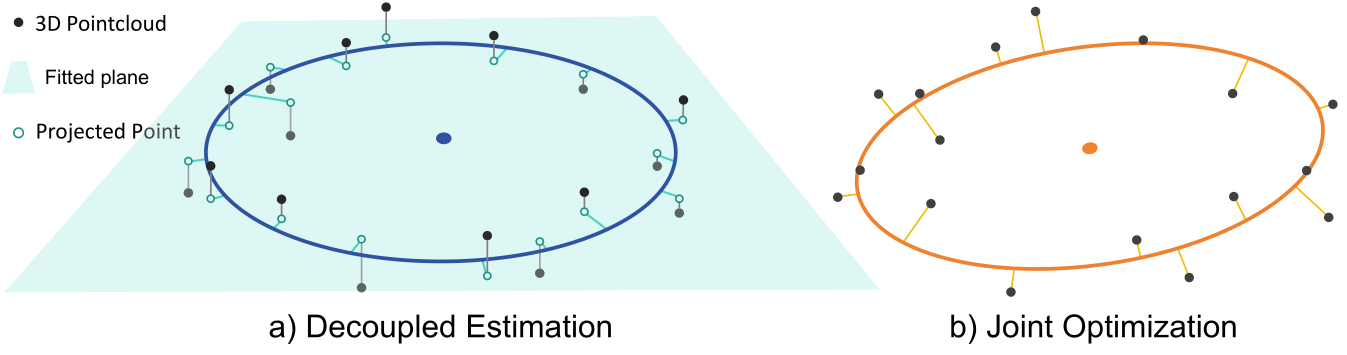
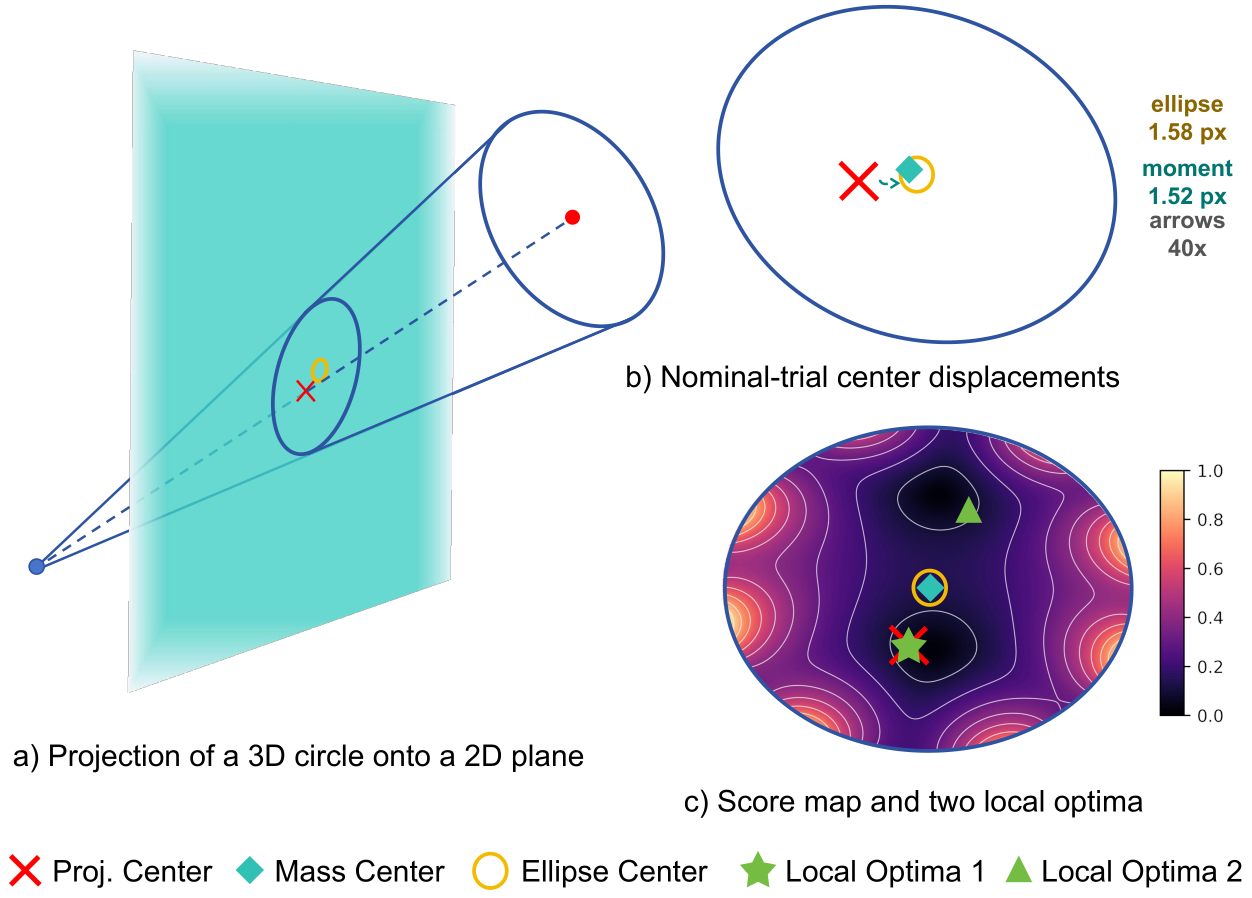
The problem has two systematic sources of error. On the LiDAR side, decoupled plane-and-circle fitting does not estimate the spatial circle directly. On the camera side, the ellipse center is generally displaced from the projection of the physical 3D center.
Method Overview
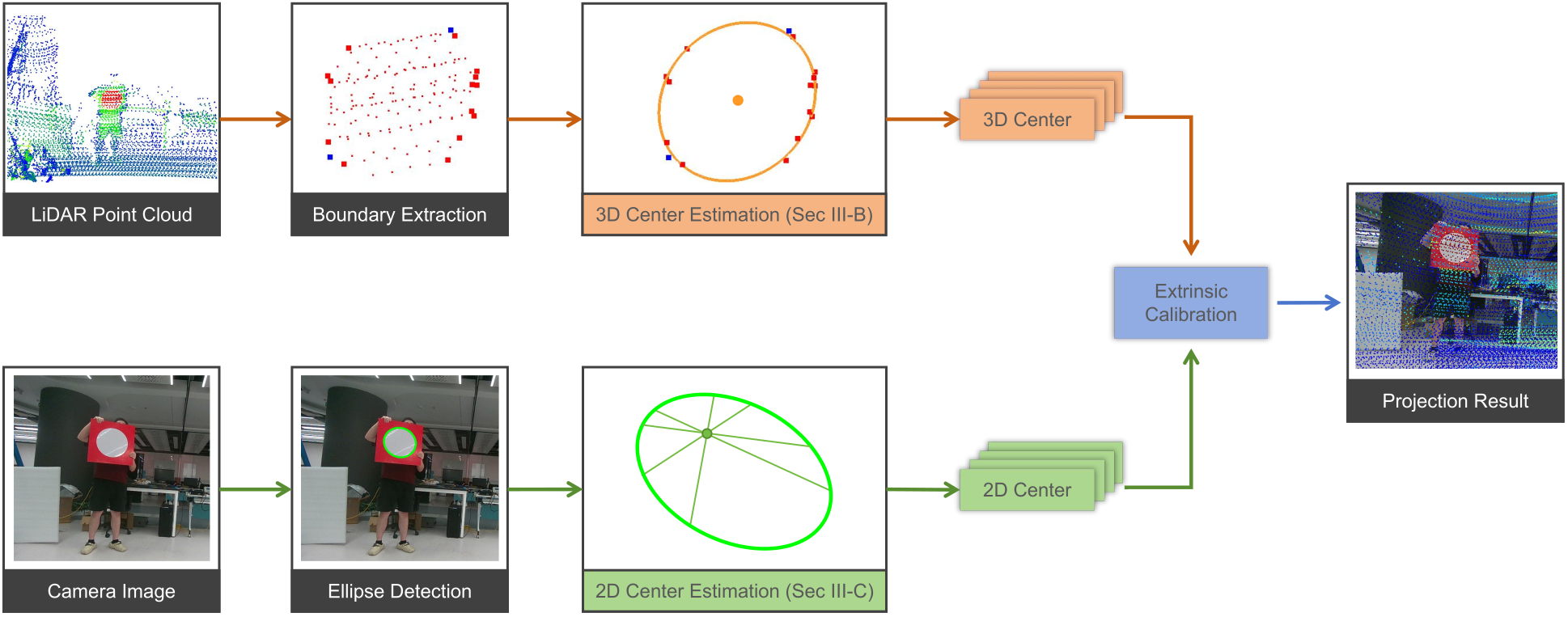
LiDAR boundary points are normalized and mapped to conformal space, where a fixed-size eigensystem jointly recovers the circle center, normal, and radius. RANSAC provides robustness to sparse observations and outliers. In the rectified image, the true projected center is found by minimizing the variance of distances recovered from chords through a candidate center.
When coplanar nonconcentric circles are available, homography validation selects the physically consistent candidate. Otherwise, Quasi-RANSAC jointly samples the two candidate branches and evaluates them through PnP reprojection consensus. The final 3D–2D center correspondences directly determine the metric six-degree-of-freedom LiDAR-to-camera transform.
Results
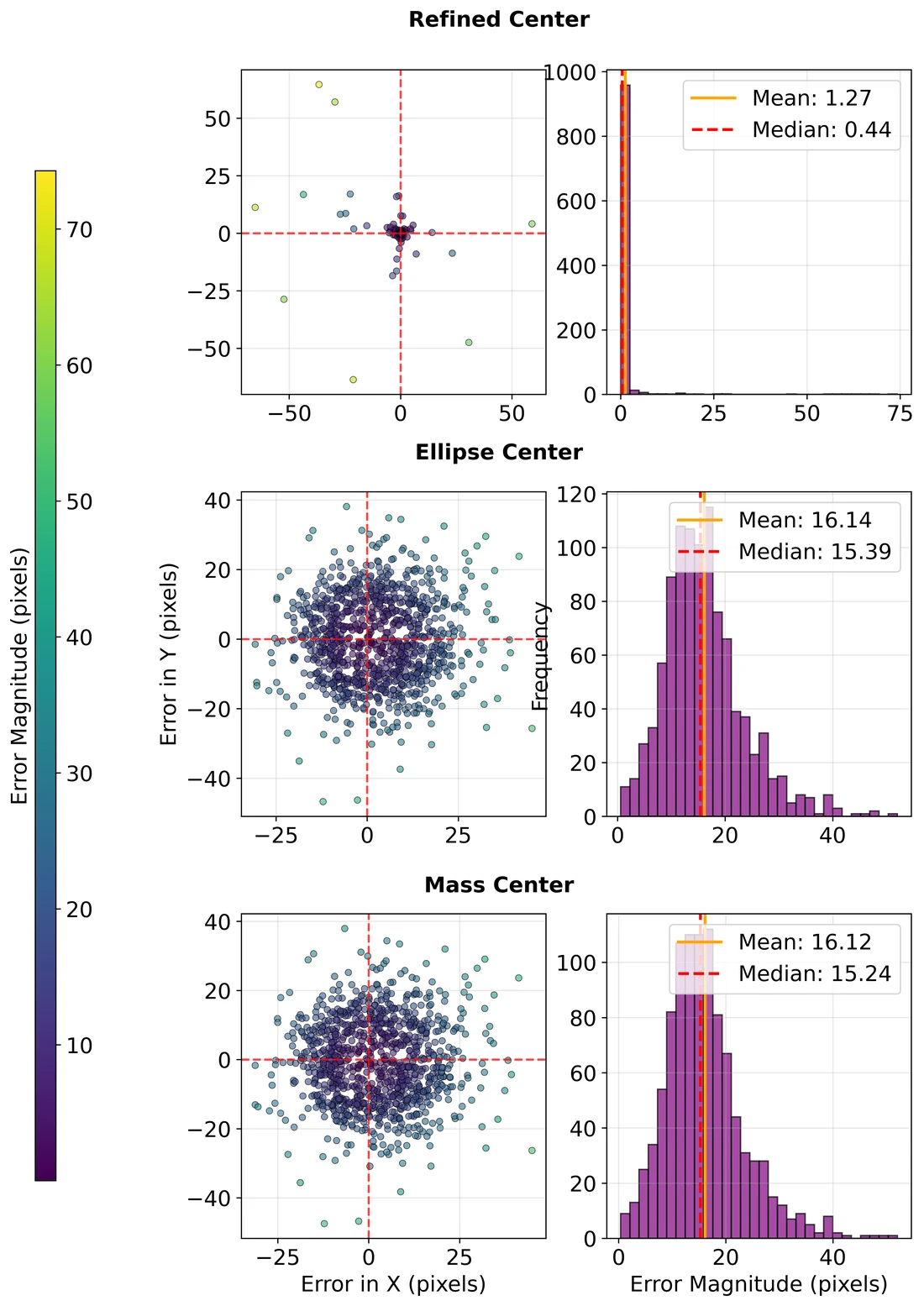
In 1,000 Monte Carlo trials with 1 px contour noise, the proposed 2D center reduces mean error from 16.14 px for the ellipse center to 1.27 px. On the Gazebo K1 multi-pose benchmark with 30 seeds, the complete pipeline also improves the end-to-end calibration results.
| Gazebo K1 | 3D center | Translation | Rotation | Reprojection |
|---|---|---|---|---|
| velo2cam | 9.45 mm | 1.16 cm | 0.13° | 2.06 px |
| Proposed | 3.48 mm | 0.65 cm | 0.10° | 0.79 px |
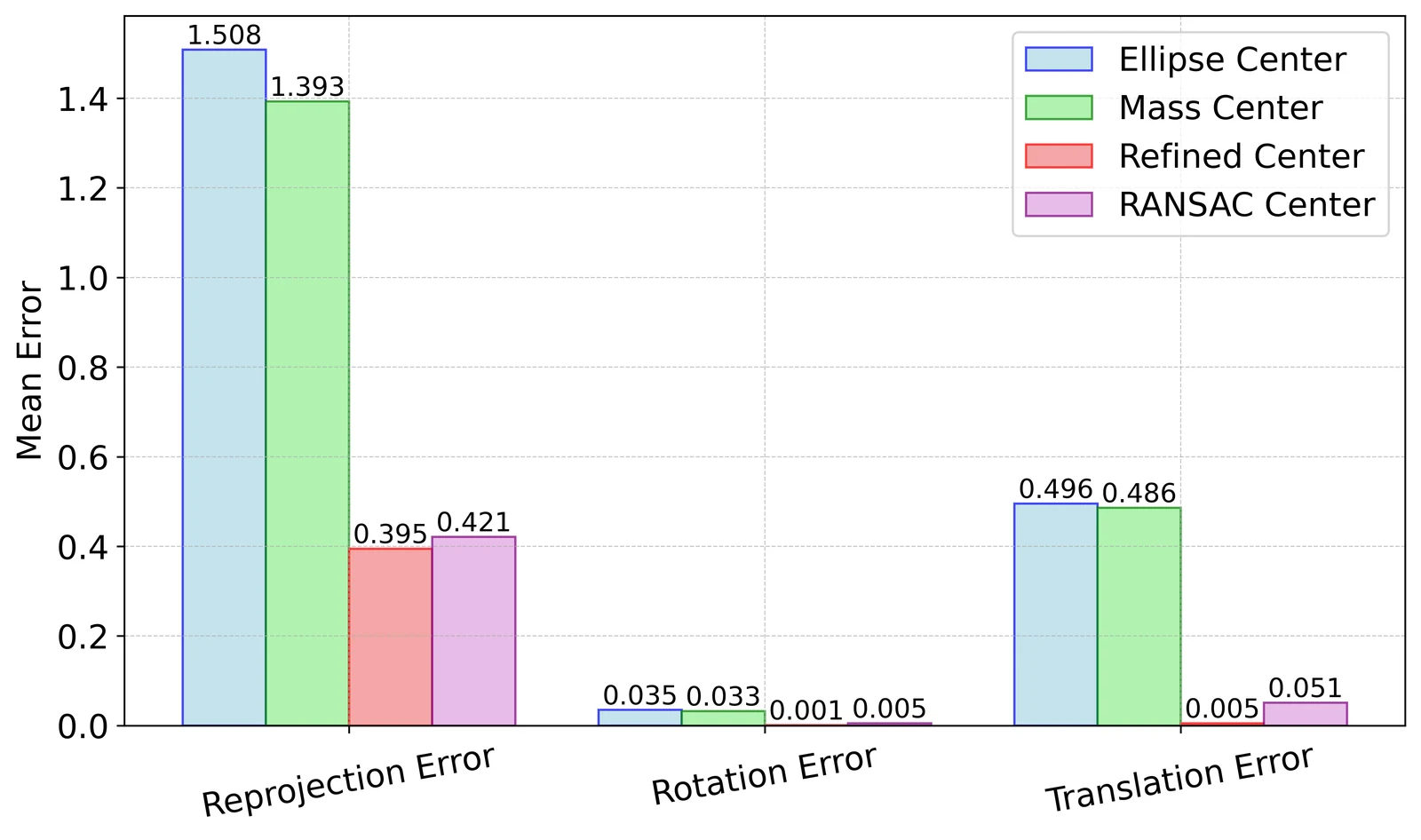
Real-World Calibration
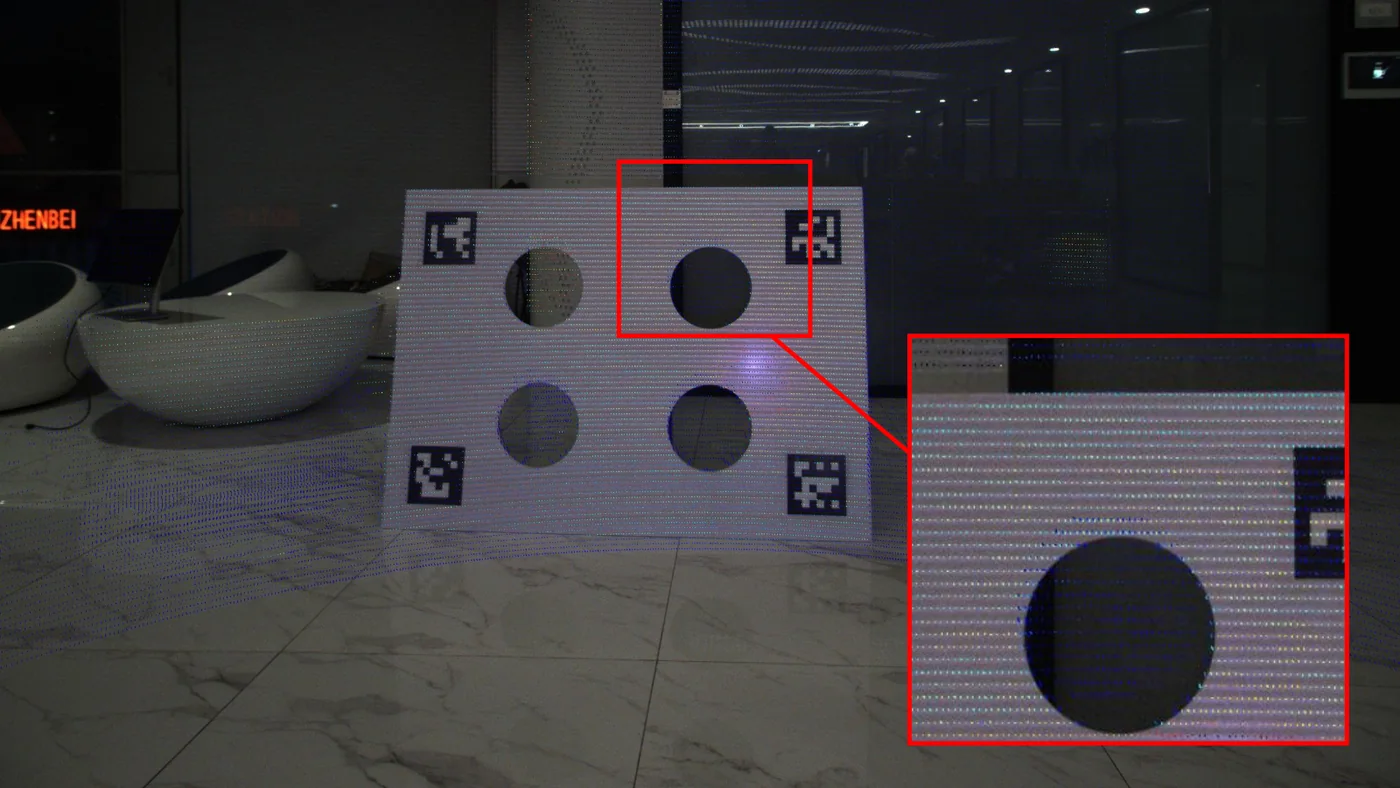
We evaluate two public datasets and two custom sensor setups. Since ground-truth extrinsics are unavailable, these examples report qualitative point-to-image alignment rather than quantitative real-world accuracy improvements.
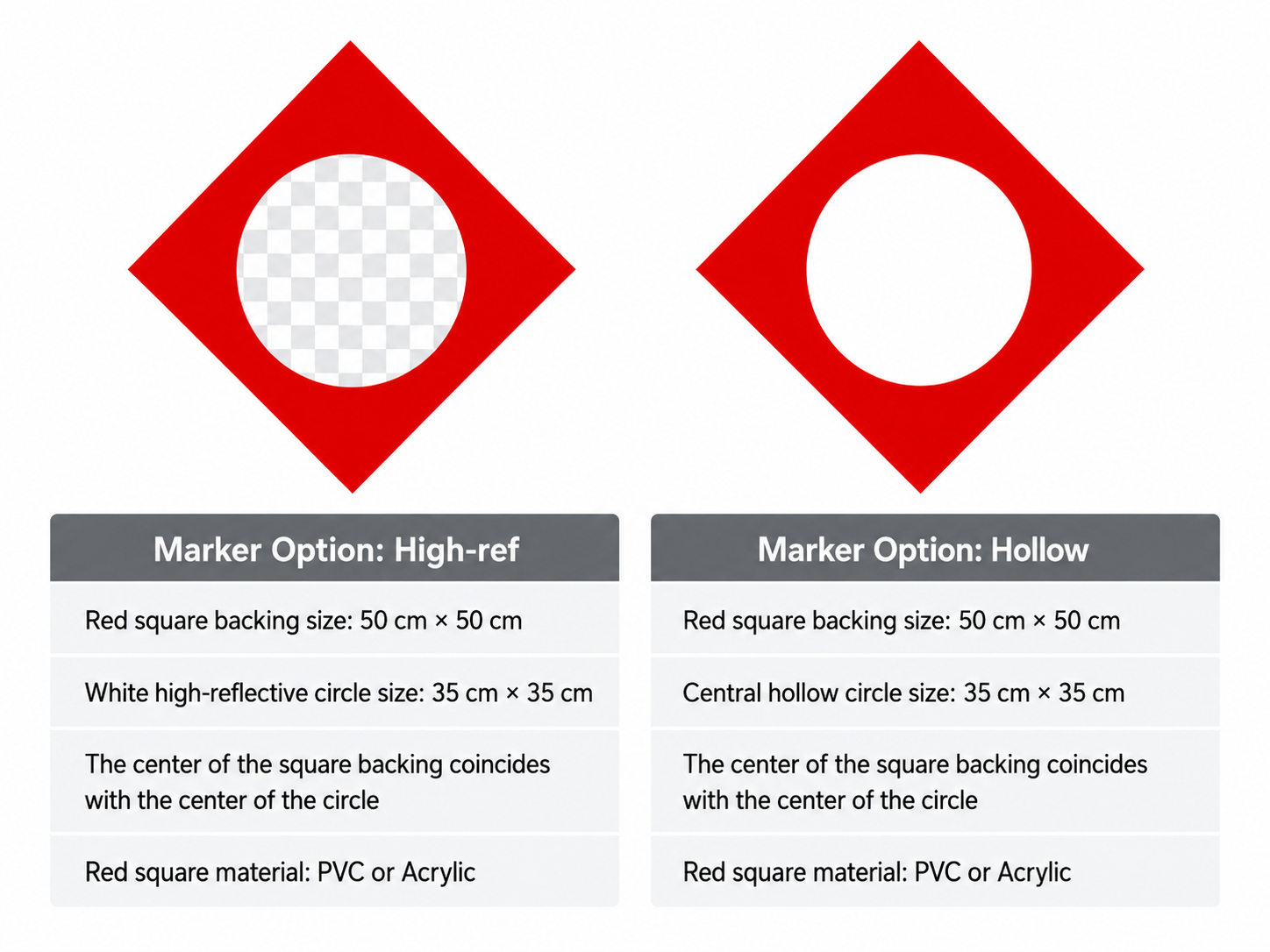
Calibration Target Details
BibTeX
@article{jiang2026accurate,
  title         = {Accurate Measurement of 3D and 2D Circular Centers With
                   Application to LiDAR-Camera Extrinsic Calibration},
  author        = {Jiang, Jiajun and Hu, Xiao and Liu, Wancheng and Jiang, Wei},
  journal       = {IEEE Transactions on Instrumentation and Measurement},
  year          = {2026},
  eprint        = {2511.06611},
  archivePrefix = {arXiv},
  primaryClass  = {cs.CV},
  url           = {https://arxiv.org/abs/2511.06611}
}