Evaluation
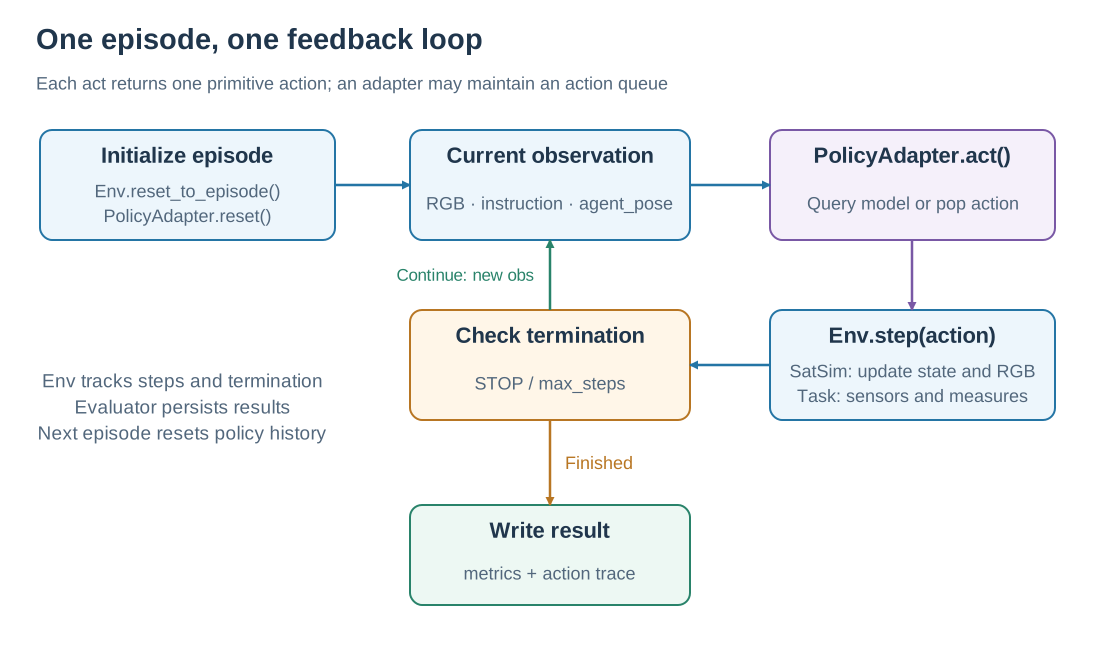
SatNav provides one online evaluation interface for the Classic Random, ReferenceFollower, Seq2Seq, and CMA baselines, as well as StreamVLN, NaVILA, Uni-NaVid, and OpenFly. All of them use the same satnav.evaluation rollout and result contract.
For illustrated definitions of Success, Oracle Success, SPL, and leave-and-return, see tasks and metrics.
1. Evaluation workflow
The shared evaluation layer:
sorts, selects, and shards Episodes by a stable key;
assigns a deterministic seed to each Episode;
performs rollouts through
PolicyAdapterand the publicEnvAPI;appends one JSONL result stream per rank;
resumes unfinished runs from existing Episode records;
aggregates scalar metrics into
summary.json.
Each baseline initializes its model, tokenizer, or processor and connects it through a PolicyAdapter. This lets Classic methods and VLMs in separate dependency environments share the same Episode selection, rollout behavior, and result format.
2. Quickstart
Train and evaluate the Classic baselines on the repository’s tiny example:
bash scripts/quickstart_models.sh
See Training Models with SatNav for dependencies, training stages, and output locations.
To call the shared Classic CLI directly:
python -m baselines.classic \
  --method random \
  --config configs/baselines/random_agent.yaml \
  --split test \
  --limit 2 \
  --max-steps 5 \
  --output-dir output/baselines/classic/random-example
Store canonical SatNav-v0.1 paths in the Git-ignored baselines/classic/.local/env.sh. After configuration, run:
bash scripts/classic/eval.sh random val_seen 8
bash scripts/classic/eval.sh reference_follower val_seen 8
bash scripts/classic/eval_parallel.sh random val_seen 2 0,1 8
scripts/classic/eval.sh uses SATNAV_MAX_STEPS=5 by default. Set a larger rollout limit explicitly:
SATNAV_MAX_STEPS=500 bash scripts/classic/eval.sh random val_seen -1
3. Episode selection and sharding
Each Episode has the stable key:
<split>::<scene_id>::<episode_id>
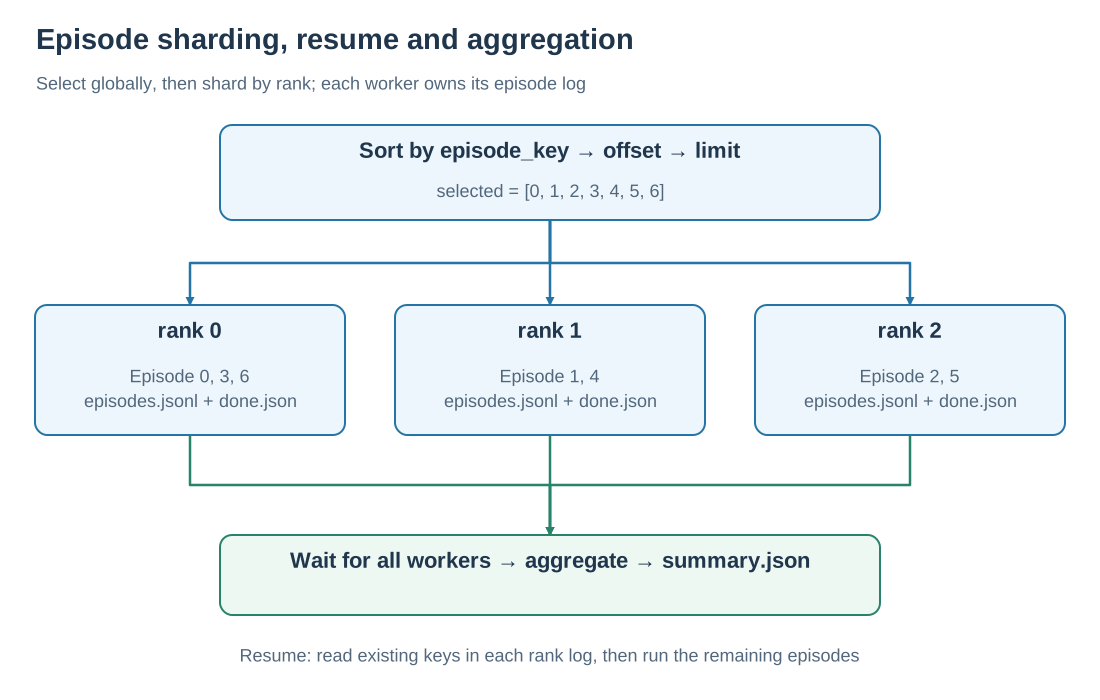
Evaluation processes Episodes in this order:
sort by stable key;
apply
offset;apply
limit;apply stride sharding, where rank
rreceivesselected[r::world_size].
limit=-1 selects all Episodes after the offset, while limit=0 selects none. The same base_seed and Episode key always produce the same Episode seed, regardless of rank count or launch order.
For seven selected Episodes and world_size=3:
rank 0: episode 0, 3, 6
rank 1: episode 1, 4
rank 2: episode 2, 5
4. PolicyAdapter
Every baseline implements three methods:
class PolicyAdapter:
    def reset(self, context): ...
    def act(self, observation): ...
    def close(self): ...
act() returns PolicyStep(action=..., info=...). The adapter owns recurrent state, KV cache, frame history, action chunking, and tokenization; these model-specific details do not belong in the shared evaluator.
For the complete path from a minimal adapter to a real model with multi-rank and resume support, see Model Integration.
EpisodeContext provides the current Episode, stable key, split, rank and world size, maximum steps, seed, and public environment reference. Adapters must not access private Env fields.
5. Output format
A single-rank run produces:
output-dir/
├── rank_00000/
│   ├── episodes.jsonl
│   └── done.json
└── summary.json
A multi-rank run produces:
output-dir/
├── rank_00000/
│   ├── episodes.jsonl
│   └── done.json
├── rank_00001/
│   ├── episodes.jsonl
│   └── done.json
└── summary.json
5.1 episodes.jsonl
Each line represents one completed or failed Episode. A successful record includes:
Field |
Meaning |
|---|---|
|
Stable Episode key |
|
Position in the globally selected Episode list |
|
Rank that wrote the record |
|
|
|
Episode seed |
|
Logical scene, Episode, and trajectory identifiers |
|
Number of primitive actions executed |
|
Environment termination reason or |
|
Scalar metrics after reset |
|
Scalar metrics at Episode completion |
|
Initial agent state, when the environment provides it |
|
Final agent state, when the environment provides it |
|
Optional sequence of actions and policy information |
Non-scalar map and image metrics are omitted from JSONL. The machine-local scene_path is not serialized by default.
When an Episode fails, SatNav records a bounded error type and generic message. It does not write a traceback or exception content that may reveal local paths.
5.2 done.json
After finishing its local shard, each rank atomically writes:
{
  "schema_version": 1,
  "rank": 0,
  "status": "complete",
  "expected_count": 2,
  "record_count": 2,
  "error_count": 0
}
The aggregator uses this file to read rank completion status and record counts.
5.3 summary.json
An aggregated result has the form:
{
  "schema_version": 1,
  "status": "complete",
  "expected_episode_count": 2,
  "record_count": 2,
  "unique_record_count": 2,
  "ok_episode_count": 2,
  "error_episode_count": 0,
  "metrics": {
    "success": 0.5,
    "spl": 0.4
  }
}
For each metric, summary.json reports the arithmetic mean of finite values from records with status=ok. If an Episode key appears more than once, the aggregator keeps the last record and exposes the difference through record_count and unique_record_count.
6. Resume
SatNav does not append to an existing output directory unless --resume is explicit:
python -m baselines.classic ... --output-dir output/run --resume
Resume performs these steps:
read the current rank’s
episodes.jsonl;truncate an incomplete final JSON line left by an interrupted process;
collect existing
episode_keyvalues;skip existing keys and run only the remaining Episodes;
rewrite
done.jsonand, for a single-rank run, aggregatesummary.jsonagain.
Reuse an output directory only when data, model, seed, world_size, and every other run condition remain unchanged. Use a new output directory after changing experiment conditions.
A complete but invalid JSONL line remains an error and is not silently removed.
7. Multi-rank evaluation and aggregation
All ranks must use the same:
Episode file and split;
offset,limit, andworld_size;base_seedandmax_steps;output directory.
After all ranks finish, run:
python scripts/evaluation/aggregate.py output/run
To fail the command when any Episode has an error:
python scripts/evaluation/aggregate.py \
  output/run \
  --fail-on-episode-error
The aggregator reads the rank_XXXXX directories that exist under the output directory. Launchers must wait for every worker to finish successfully before aggregation; the aggregator does not infer which rank directory is missing.
8. Error handling
By default, an Episode exception is persisted as status=error, and evaluation continues with the remaining Episodes.
--fail-faststops the worker immediately after writing the current error record;--fail-on-episode-errorcompletes rollout and aggregation, then makes the command fail if any error record exists;with neither option, the result status is
completed_with_errorsand a summary is still produced.
9. Classic CLI
For the full SatNav-v0.1 workflow covering data preparation, Seq2Seq and CMA training, and single- or multi-GPU evaluation, see Classic Baselines.
All four methods use the same CLI:
python -m baselines.classic --help
Common arguments:
Argument |
Meaning |
|---|---|
|
|
|
Baseline YAML; defaults to the configuration for the selected method |
|
Dataset split |
|
Output directory |
|
Selection range after global sorting |
|
Stride-sharding parameters |
|
Base seed |
|
Maximum primitive actions per Episode |
|
Skip existing Episode keys |
|
Seq2Seq or CMA model inputs |
|
Repeatable OmegaConf override |
|
Resolve and print configuration without creating a dataset or model |
10. VLM entry points
The four VLM integrations use separate environments but share the same selection and result arguments:
python -m baselines.vlm.streamvln.evaluate --help
python -m baselines.vlm.navila.evaluate --help
python -m baselines.vlm.uninavid.evaluate --help
python -m baselines.vlm.openfly.evaluate --help
For a five-step smoke rollout, pass --max-steps 5:
bash baselines/vlm/streamvln/scripts/eval.sh \
  --model-path /path/to/model \
  --episodes /path/to/all_episodes.json \
  --scenes-dir /path/to/scenes \
  --limit 1 \
  --max-steps 5 \
  --output-dir output/baselines/vlm/streamvln/smoke
Each VLM guide explains its model path, upstream checkout, processor, isolated Python environment, training, and single- or multi-GPU evaluation:
11. Python API
A minimal integration looks like this:
from satnav.evaluation import (
    EvaluationConfig,
    Evaluator,
    PolicyAdapter,
    PolicyStep,
)

class StopPolicy(PolicyAdapter):
    def reset(self, context):
        self.context = context

    def act(self, observation):
        return PolicyStep(action=0, info={"reason": "example"})

    def close(self):
        pass

summary = Evaluator(
    environment=env,
    policy=StopPolicy(),
    config=EvaluationConfig(
        output_dir="output/example",
        split="test",
        policy_id="stop-policy",
        limit=2,
        max_steps=5,
    ),
).run()
satnav.evaluation does not import PyTorch or any trainer. Only a concrete baseline factory or adapter should load its model framework.
12. Troubleshooting
Why does evaluation reject an existing output directory?
The directory already contains rank records or a completion marker. Add --resume only when continuing the same run; otherwise, use a new output directory.
Why was an Episode not rerun after resume?
The current rank’s JSONL already contains the same episode_key. To rerun it, use a new output directory instead of manually combining JSONL files from different runs.
Why is the Episode count in a multi-rank summary incorrect?
Confirm that all workers use the same world_size and output directory, and run aggregation only after every worker has completed.
Why is there no top-down map in the results?
The shared JSONL format retains scalar metrics only. Save image and map payloads through a separate video or visualization hook.
Which LandmarkSet threshold should I use: 3 m or 30 m?
Online evaluation uses the 30 m threshold in configs/satnav_eval_task.yaml. The 3 m threshold in trajectory-generation configurations is only for determining whether an expert waypoint has been reached.