Architecture
简体中文 | English
See dual memory and sliding windows for the end-to-end data flow and training objective, and historical memory and token compression for the memory algorithms.
SwiftVLN separates training, online evaluation, model extensions, and simulator adapters into independent modules. Training reads offline trajectories, while evaluation connects to SatNav or Habitat through a Backend. Both pipelines share the model, Memory processing, embedding enhancements, and experiment configuration.
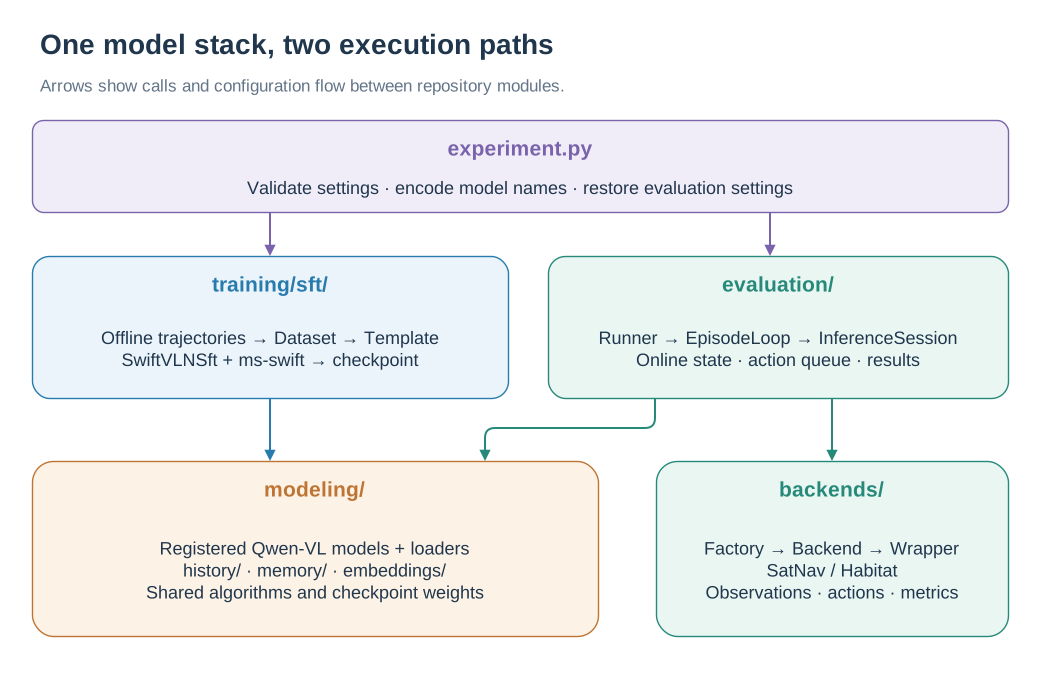
Training and evaluation call shared modeling components; the evaluation path also connects to simulator backends.
1. Repository structure
SwiftVLN/
├── src/swiftvln/
│   ├── experiment.py          # Experiment constraints and model-name codec
│   ├── training/sft/          # Training arguments, Dataset, and ms-swift trainer
│   ├── modeling/              # Models, Template, Memory, and embeddings
│   ├── evaluation/            # Online evaluation, inference state, and result persistence
│   ├── backends/              # SatNav / Habitat adapters
│   ├── data/                  # Habitat trajectory generation and validation CLI
│   ├── configs/               # Packaged evaluation task configurations
│   └── utils/                 # Distributed, image, and video utilities
├── scripts/
│   ├── train/                 # Training launchers
│   ├── eval/                  # Evaluation launchers
│   ├── queue/                 # File-based queues
│   └── lib/                   # Shared shell functions
├── tools/s2r/                 # SatDronePair and Satellite-to-UAV Stage-A tools
├── environments/             # swiftvln-train / swiftvln-eval environment definitions
├── third_party/               # Pinned external source trees
└── docs/                      # User and development documentation
src/swiftvln is the installable Python package. Shell launchers, offline Satellite-to-UAV tools, and documentation are repository-level assets and are not part of the core package.
2. Configuration and model name
experiment.py defines SwiftVLNExperimentSpec, the source of truth for:
Environment and model families;
Trajectory window, future steps and overlap;
Memory method and history processor;
system prompt and embedding enhancement;
Map memory environment and parameter constraints;
Model name generation, parsing and shell/JSON output.
The training script calls build-name before launch. eval_by_name.sh uses the same module to parse the model name and restore evaluation parameters:
training variables ──> SwiftVLNExperimentSpec ──> model name
                                                     │
                                                     ▼
evaluation variables <── shell assignments <── parse-name
The training parameters and evaluation parameters are respectively defined in:
Configuration entry point |
Location |
|---|---|
Shared experimental constraints |
|
Training parameters |
|
Evaluation parameters |
|
Training startup default value |
|
Evaluation startup default value |
|
3. Training pipeline
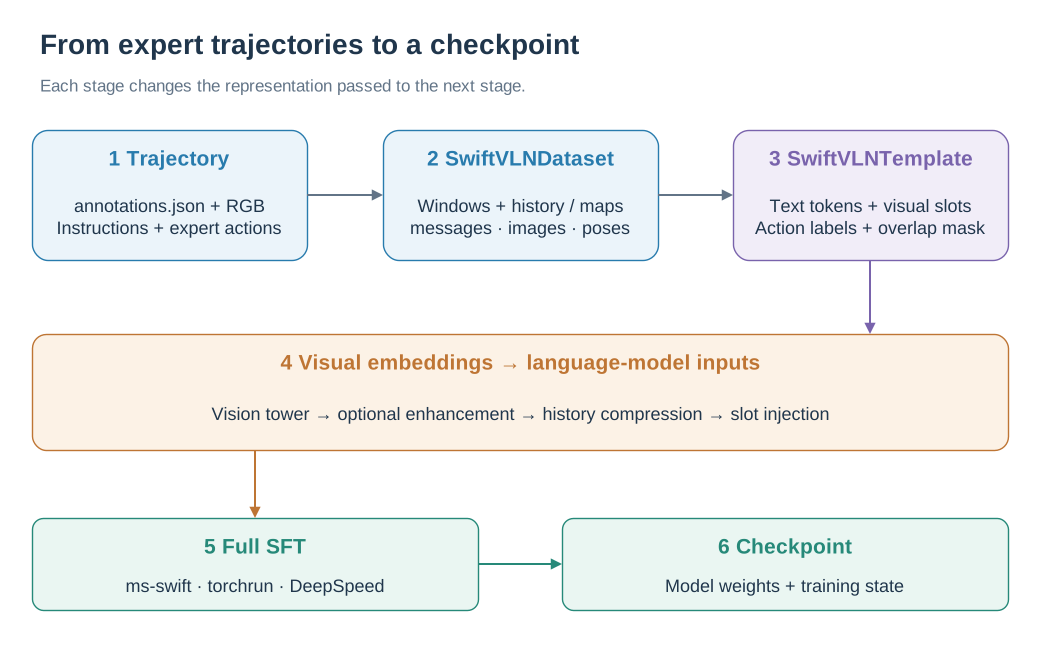
Trajectory windows become multimodal conversations, then embeddings and supervised action labels.
3.1 Dataset
training/sft/dataset.py reads one or more trajectory directories containing annotations.json and performs the following operations:
Split trajectories into windows using
NUM_FRAMESandNUM_OVERLAP;Organize multi-turn action prediction using
NUM_FUTURE_STEPS;Set loss mask for context assistant turn in overlapping window;
Sampling historical RGB, or generating SatNav Map memory;
Construct initial observations and relative poses;
Output multimodal dialogue samples accepted by ms-swift.
The core fields output by Dataset are:
Field |
Content |
|---|---|
|
System, user image turn and assistant action turn |
|
History, initial observation, current observation, in that order |
|
Template Number of historical images to be processed |
|
Initial number of observations in System prompt |
|
|
|
Pose aligned with image sequence when pose enhancement is enabled |
3.2 Template
modeling/template.pyfor Qwen2.5-VL and Qwen3-VL registers SwiftVLN Template. Template uses two special tokens:
Token |
Purpose |
|---|---|
|
Compressed history Memory token block |
|
Visual token block of Initial/current observation |
During encoding, the Template first computes the placeholder-token count. After vision-tower encoding, it calls the history processor and injects the resulting embeddings into the placeholders. Image order, placeholder count, and visual-embedding count must remain aligned.
3.3 Trainer and Checkpoint
training/sft/trainer.py extends ms-swift SwiftSft. It detects VLN trajectories, creates SwiftVLNDataset, configures the Template history processor, and attaches embedding enhancements. ms-swift trains and saves the model, optimizer, scheduler, and enhancement parameters.
4. Evaluation pipeline
The runner loads the checkpoint, assigns episodes, and records completed results. Inside each episode, the loop below alternates between model queries and environment actions.
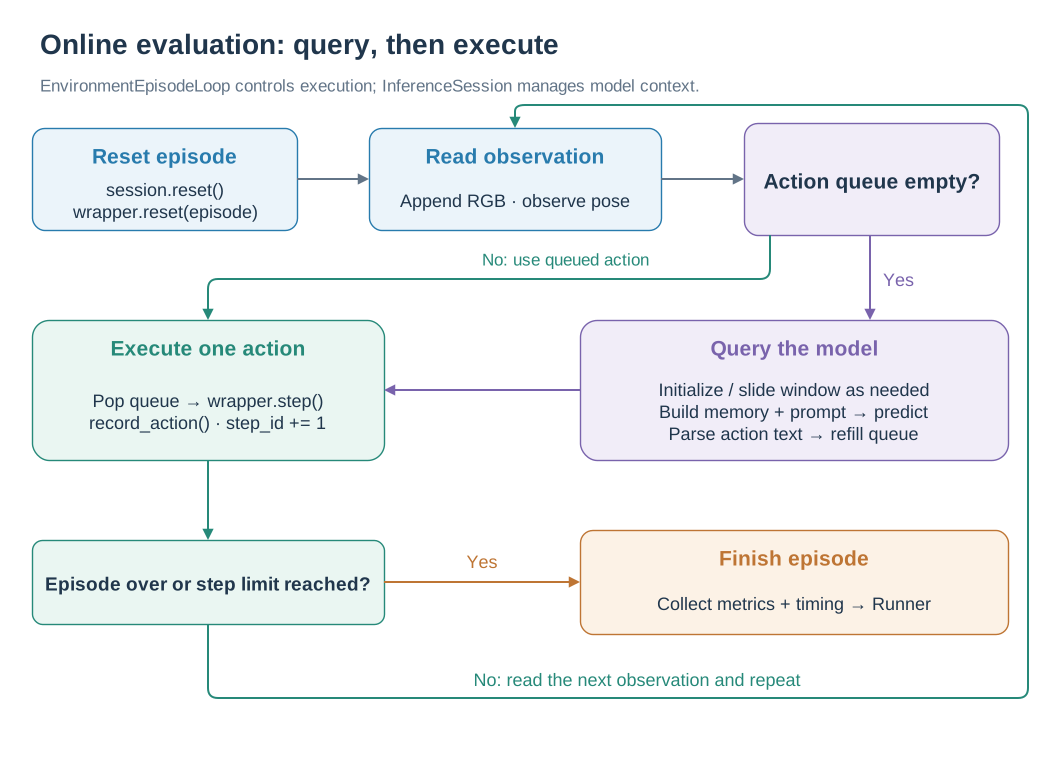
Only an empty action queue triggers a model query; each environment step executes one queued action.
SwiftVLNInferenceSession builds prompt tokens, encodes images, and injects embeddings directly. It maintains the online conversation window and memory cache as the simulator advances.
4.1 Runner
evaluation/runner.py handles model loading, distributed initialization, episode allocation, resume, and result aggregation. Episodes are stably sorted by scene and then sharded round-robin.
4.2 Episode loop
evaluation/episode_loop.py handles only the reset → predict → step → metrics state machine. Each episode starts with session.reset() to clear inference state. The Backend supplies observations, executes actions, and saves video.
4.3 Inference session
evaluation/inference/ Split by responsibility:
Modules |
Responsibilities |
|---|---|
|
Combined inference parameters, processor, Memory builder and generation entry |
|
Construct system/user/assistant token and final |
|
Encode initial/current/history image and build Memory cache |
|
Save turn, overlap context, pose and sliding window state |
5. Modeling
5.1 Model registration
modeling/registry.py uses register_swiftvln_models() to register:
Transformers config and model class;
ms-swift model metadata and loader;
Qwen2.5-VL / Qwen3-VL Template;
SwiftVLN special visual token.
Importing swiftvln does not trigger model registration. Training and evaluation entry points call the registration function explicitly before parsing or loading a model.
5.2 History processor
modeling/history/ provides a unified interface:
get_output_token_count(...)  # compute placeholder-token count before encoding
process(...)                 # process visual embeddings
Current implementations include per-frame pooling/GridToMe, GTC, and Segment-GTC. Training Template and Online Inference sessions use the same factory and the same set of processor parameters.
5.3 Memory
modeling/memory/ implements SatNav Map memory. It parses episode and trajectory metadata, reconstructs paths from actions, renders global and local explored maps, and manages the disk cache. Both history RGB and Map memory are converted into visual tokens for injection by the Template or inference session.
5.4 Embedding enhancement
modeling/embeddings/ processes per-image embeddings after the vision tower and before history compression. EMBEDDING_MODE is mutually exclusive: none, pose, posefilm, or uav.
EmbeddingEnhancementPipeline stores modules in nn.ModuleDict, so enhancement parameters are included in model.parameters() and the checkpoint state_dict. The model loader restores embed_enhance.* weights from safetensors.
6. Backend boundary
Core training, inference, and episode loops access environment capabilities through static semantics and shared interfaces. The Backend is organized into three layers:
Level |
Position |
Responsibilities |
|---|---|---|
Static semantics |
|
Action symbols, forward distance, steering angle, prompt and ability flags |
Backend |
|
Load configuration, create simulator, parse actions and video hooks |
EnvWrapper |
|
Unified reset, step, observation, metrics and Episode access |
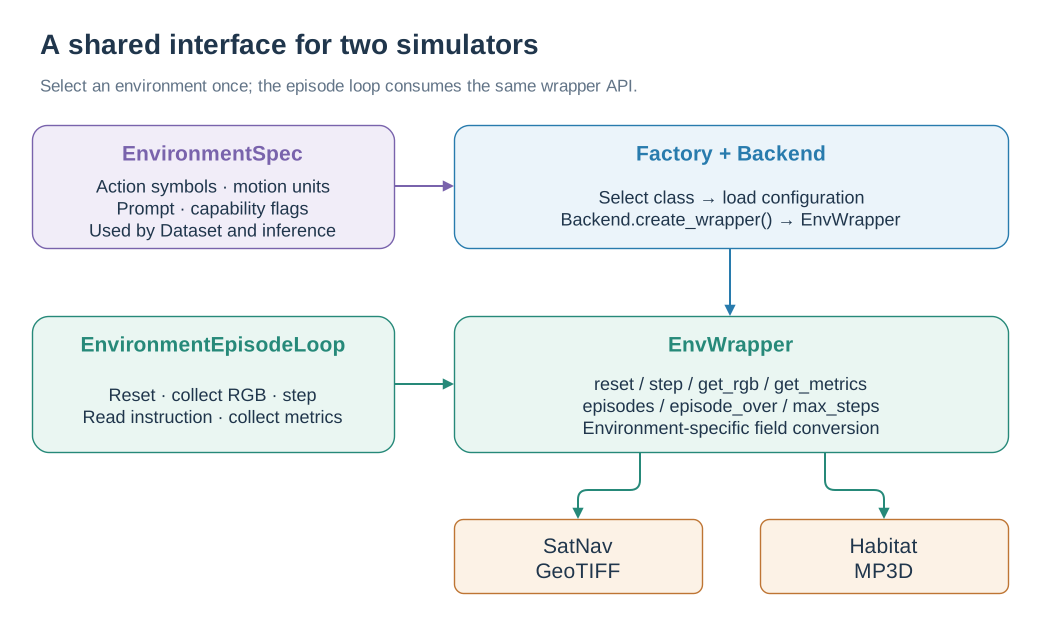
EnvironmentSpec supplies static semantics, Backend creates the simulator, and EnvWrapper exposes a common interface.
backends/factory.py imports a Backend only after its environment is selected, so simulator dependencies are loaded on demand.
The unified interfaces of EnvWrapper include:
reset(),step()andclose();get_rgb(),get_instruction()andget_metrics();episodes,episode_over,max_stepsandenv_type.
7. Result persistence and distribution
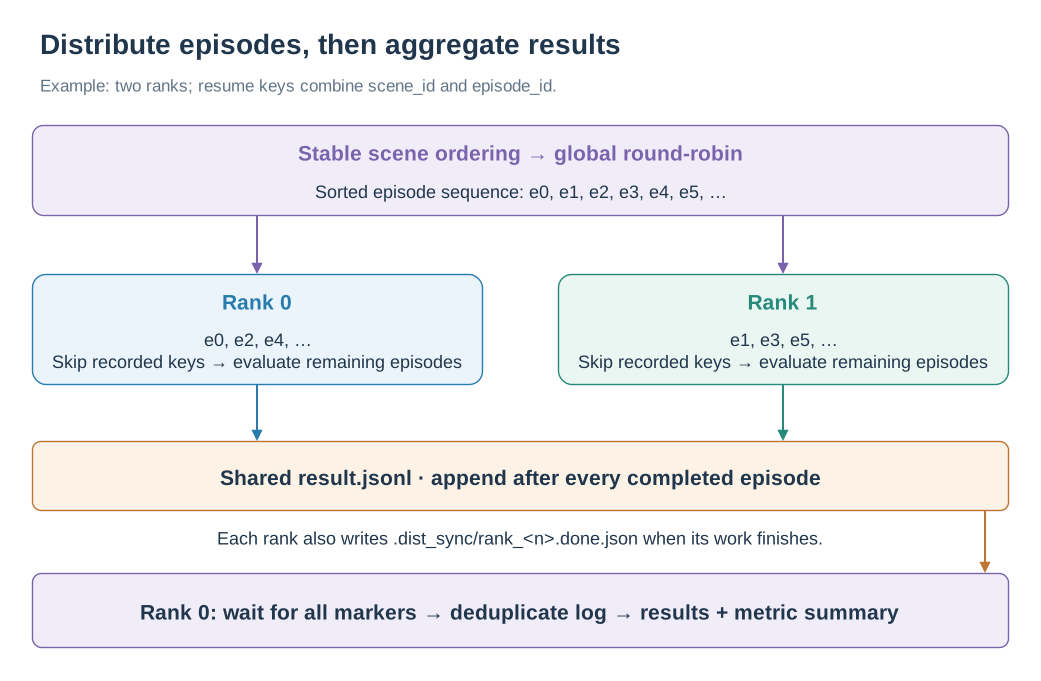
Ranks append to a shared episode log; rank 0 waits for completion markers before deriving the final results.
Training is managed by torchrun + DeepSpeed model sharding, optimizer and checkpoint, and the model name is also used as Output directory name. When SwanLab is enabled, the training script additionally writes train_metadata.json to record project, experiment name and run URL.
Evaluation using evaluation/results.pypersistence:
Product |
Function |
|---|---|
|
Append-only resume log written after each completed episode |
|
Final results deduplicated by |
|
Metrics, model configuration, split and GPU information |
|
Time-consuming statistics of each inference stage |
|
Completion mark of each rank |
Rank 0 waits for every completion marker, then generates final results and summaries from result.jsonl. When an incomplete output directory is reused, existing scene_id::episode_id entries are skipped.
8. Satellite-to-UAV dependency direction
Data transformation, manifest, training and retrieval evaluation for Satellite-to-UAV Stage-A at tools/s2r/, only from the repository checkout runs. SwiftVLN package only retains the adapter structure and checkpoint required to run the model loader:
tools/s2r/ ──> src/swiftvln/modeling/embeddings/s2r_adapter.py
                         ▲
                         │
src/swiftvln/modeling/embeddings/uav_adapter.py

src/swiftvln/  -X->  tools/s2r/
The core package does not import tools/s2r, and offline data dependencies do not enter the SwiftVLN training and evaluation runtime.