SwiftVLN Documentation
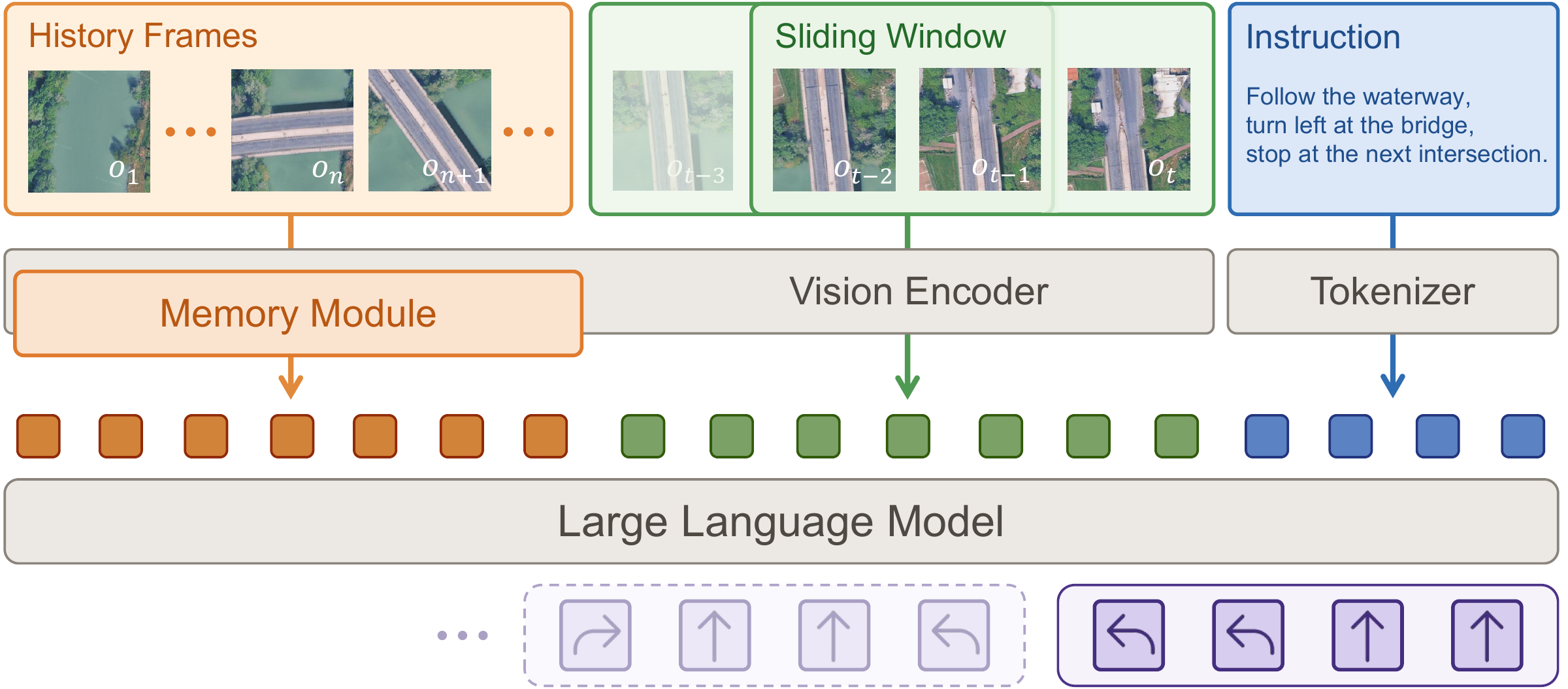
SwiftVLN brings trajectory-based training, memory experiments, and online evaluation into one framework. It supports Qwen2.5-VL and Qwen3-VL for SatNav aerial navigation and Habitat indoor navigation.
Start here
Your goal |
Guide |
|---|---|
Understand the implementation |
Dual memory and windows · History compression · Map memory · Input augmentation |
Evaluate a released model |
|
Train a navigation policy |
|
Compare memory designs |
|
Adapt to UAV observations |
|
Extend the framework |
Training and evaluation workflow
Prepare an environment, download a base model or navigation checkpoint, and configure local data paths. Training uses offline RGB observations and expert actions; evaluation runs the policy online on SatNav or Habitat episodes. Use the same model name to carry memory and window settings from training into evaluation.
The workflow guide connects the setup, data, training, evaluation, and development documents. The reference configuration uses 32-action windows, four actions per prediction, and eight uniformly sampled history frames.
Project resources
Paper: SatNav: A Scalable Benchmark for Long-Horizon UAV Vision-Language Navigation from Satellite Imagery.
SwiftVLN Model Zoo: reference and memory ablation checkpoints.
SatNav Wiki: simulator, episodes, satellite scenes, and baseline documentation.
Source code: models, scripts, configuration, and documentation sources.